
In the world of AI, the quality of your output is directly tied to the quality of your input. A well-crafted prompt is the difference between a generic, useless response and a brilliant, insightful piece of content. But what exactly makes a prompt “perfect”? It’s not about magic words; it’s about a structured approach that gives the AI all the information it needs to deliver exceptional results.
This guide will dissect the anatomy of a perfect prompt, breaking it down into five essential components. By mastering this framework, you can move from a frustrating process of trial and error to a reliable system for getting the content you want, every time. For a deeper look at what to avoid, check out our article on 10 Prompt Engineering Mistakes.
The 5 Core Components of a Perfect Prompt
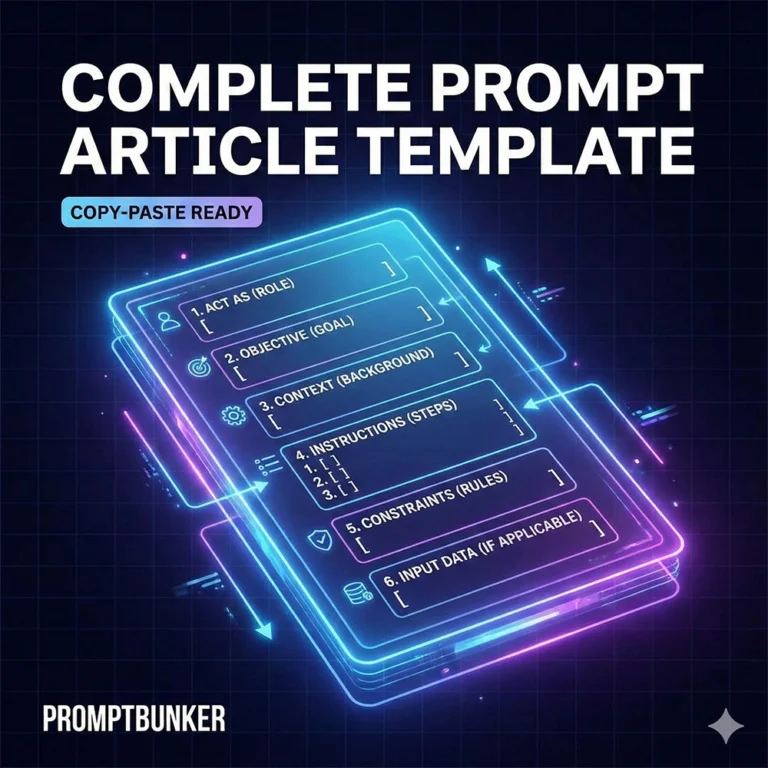
A perfect prompt is like a detailed creative brief for your AI assistant. It should be clear, contextual, and specific. Here are the five components that every great prompt should include:
- The Persona: Who the AI should be.
- The Task: What the AI should do.
- The Context: The background information.
- The Format: How the output should be structured.
- The Constraints: The rules the AI must follow.
Let’s break down each one.
1. The Persona: Assign a Role to the AI
Start by telling the AI who it is. Assigning a persona or role is the fastest way to tap into a specific domain of its knowledge. This immediately narrows its focus and improves the quality and relevance of the response.
- Vague: “Write about email marketing.”
- With Persona: “Act as an expert email marketing strategist with 15 years of experience in the e-commerce fashion industry.”
This simple addition transforms the AI from a generalist into a specialist. Our PromptBunker Webflow Accelerator Kit includes a library of pre-built personas for various marketing tasks.
2. The Task: Be Explicit About the Goal
Clearly and concisely state what you want the AI to do. Use action verbs and be as specific as possible. Don’t assume the AI knows what you mean.
- Vague: “I need some blog ideas.”
- With a Clear Task: “Generate a list of 10 blog post titles about the topic of sustainable web design. The titles should be engaging and optimized for a high click-through rate.”
For more on creating a full content plan, see our guide on AI Prompts for Content Strategy & Planning.
3. The Context: Provide the Necessary Background
Context is the “who, what, where, when, and why” that surrounds your task. It’s the background information the AI needs to understand the full picture. This is often the most overlooked but most critical component.
- Vague: “Write a product description.”
- With Context: “Write a 150-word product description for a new line of noise-cancelling headphones called ‘Serenity’. The target audience is frequent flyers and remote workers. The key benefit is uninterrupted focus.”
For more on this, our AI Prompts for E-commerce Product Descriptions guide offers dozens of contextual examples.
4. The Format: Specify the Desired Structure
If you don’t tell the AI how to structure the output, you’ll likely get a dense wall of text. Specify the exact format you need, whether it’s a list, a table, a JSON object, or a specific heading structure.
- Vague: “Compare Shopify and WooCommerce.”
- With a Specific Format: “Create a two-column comparison table for Shopify and WooCommerce. Include rows for ‘Pricing’, ‘Ease of Use’, ‘Scalability’, and ‘App Ecosystem’.”
This makes the output immediately usable and saves you the time of reformatting it yourself.
5. The Constraints: Set the Rules and Boundaries
Constraints are rules that guide the AI and force it to be more creative and focused. This can include word count, tone of voice, keywords to include or avoid, and the overall style.
- Vague: “Write a tweet about our new app.”
- With Constraints: “Write a tweet announcing our new fitness app, ‘Momentum’. The tweet must be under 280 characters, include the hashtag #GetMomentum, avoid using the word ‘easy’, and end with a question to encourage engagement.”
For more advanced ways to guide the AI, explore our article on Advanced Prompt Engineering Techniques.
Putting It All Together: A Perfect Prompt Example
Here’s an example that combines all five components:
[Persona] Act as a senior conversion copywriter specializing in SaaS landing pages.
[Task] Write three alternative headlines for a new project management app called ‘FlowState’.
[Context] The app is designed for small, agile teams who find traditional tools like Jira too complex. The main selling point is its simplicity and intuitive interface.
[Format] Present the headlines as a numbered list.
[Constraints] Each headline must be under 10 words and focus on the benefit of ‘effortless productivity’.
Conclusion: From Good to Perfect
By consistently applying this five-part framework, you can elevate your prompt engineering skills and dramatically improve the quality of your AI-generated content. It’s a systematic approach that takes the guesswork out of the process and puts you in full control of the output.
Ready to put this into practice? The PromptBunker Webflow Accelerator Kit is packed with prompts that are already built using this perfect structure, giving you a head start on creating high-quality content.