
You’re getting traffic to your landing page, but your conversion rate is flat. You know you need to optimize, but where do you even start? The process of analyzing data, forming hypotheses, and running A/B tests can feel slow and overwhelming.
This is where ChatGPT can become your secret weapon. By following a structured framework, you can use AI to accelerate every step of the landing page optimization process. This isn’t just about writing copy; it’s about using AI as a strategic partner to make data-driven decisions.
This guide will walk you through our 7-step framework for using ChatGPT to optimize your landing pages for higher conversions.
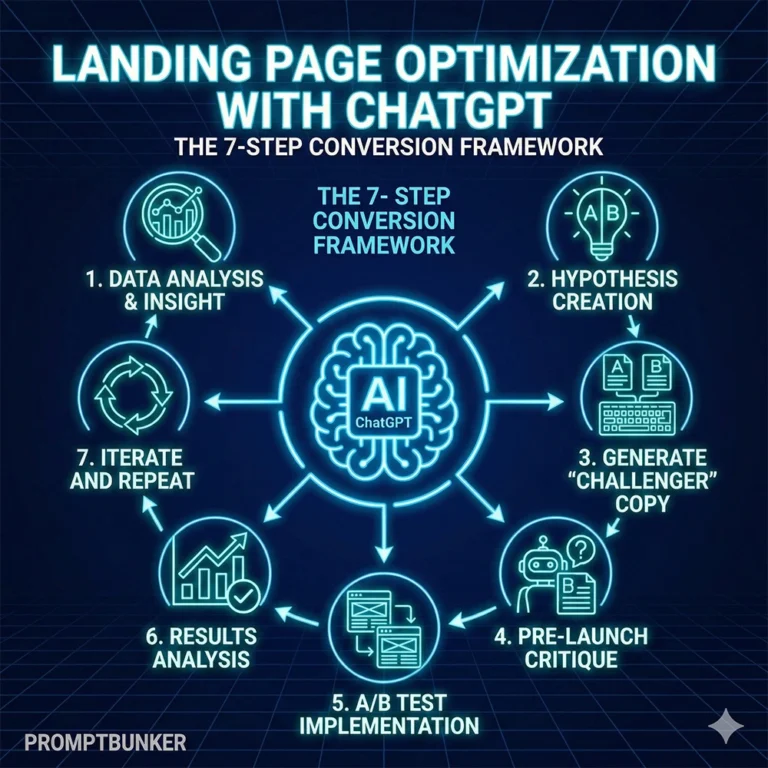
The 7-Step Conversion Framework
Step 1: Data Analysis & Insight Generation
Goal: Turn raw data into actionable insights.
Feed ChatGPT your raw data—user feedback, survey results, heatmap descriptions, or even Google Analytics data—and ask it to find the patterns.
Prompt:
`”Act as a conversion optimization specialist. Analyze the following user feedback and identify the top 3 reasons why users are not converting.
[Paste User Feedback Here]”`
Step 2: Hypothesis Creation
Goal: Create clear, testable hypotheses based on your insights.
Prompt:
“Based on the insight that [Your Insight], generate 3 testable hypotheses in the format: ‘By changing [Element] to [New Version], we can increase [Metric] because [Reason].'”
Step 3: Generate “Challenger” Copy
Goal: Create a new version of your copy to test against the original.
Prompt:
`”Based on the hypothesis that [Your Hypothesis], rewrite the following headline to be more benefit-oriented. Generate 3 variations.
[Paste Original Headline Here]”`
Step 4: Pre-Launch Critique
Goal: Get the AI to critique its own work before you go live.
Prompt:
`”Act as a skeptical user. Read the following landing page copy and identify 3 potential points of confusion or objection.
[Paste New Landing Page Copy Here]”`
Step 5: A/B Test Implementation
Goal: Set up and run your A/B test using a tool like Google Optimize, Optimizely, or your landing page builder’s built-in features.
Step 6: Results Analysis
Goal: Interpret the results of your A/B test.
Prompt:
`”Analyze the following A/B test results. Was the test statistically significant? Which version should we adopt?
- Control: [Conversion Rate]
- Challenger: [Conversion Rate]”`
Step 7: Iterate and Repeat
Goal: Use the learnings from your test to inform the next one.
Prompt:
“Based on the winning variation, what is the next logical element of the page to test? Suggest one new hypothesis for our next A/B test.”
A System for Continuous Improvement
By following this 7-step framework, you move from random acts of optimization to a systematic, data-driven process. You use AI not just as a writer, but as an analyst, a strategist, and a partner in your conversion optimization efforts.
This is a more advanced application of the principles we cover in our guide on How to Optimize Landing Pages with ChatGPT. It’s about building a repeatable system for continuous improvement.
Want to get a complete set of prompts for every step of this framework? The PromptBunker Webflow Accelerator Kit includes a dedicated section on conversion optimization, with prompts designed to help you implement this entire workflow, faster.